
THE SELFISH GIANT

 THE SELFISH GAINT

Oscar Wilde

  • Oscar Wilde (1854-1900) was an Irish wit, poet, novelist, and playwright. Wilde was born of professional and literary parents. His father, Sir William Wilde, was an ear and eye surgeon. His mother was a revolutionary poet and an authority on Celtic myth and folklore. 
  • Wilde became one of the best-known personalities of his day. He is best known for his only novel, The Picture of Dorian Gray (1891), and his comic masterpieces Lady Windermere’s Fan (1892) and The Importance of Being Earnest (1895).  
  • 'The Selfish Giant' is a short fantasy story for children written by Oscar Wilde. It was first published in the anthology The Happy Prince and Other Tales in 1888. This story is about a giant who learned an important lesson about love and sharing and holds different meanings for people of different age. 
  • The moral of the story is Happiness through true love and selflessness.

Characters:

  1. Giant
  2. Cornish Ogre
  3. Children
  4. Linnet (bird)

SYNOPSIS

    • The story is about a giant who is said to be very selfish.
    • He had a very beautiful garden where the children played when he was away for seven years.
    • One summer’s afternoon the giant returned to his garden from a seven-year visit to his friend, a Cornish ogre. Furious at finding the children trespassing, he chases them out and proceeds to build a wall around his garden. He erects a sign reading: “TRESPASSERS WILL BE PROSECUTED.” The children are very sad, as playing on the road is a poor substitute.
    • By his selfishness, a very high wall was built around his garden so that the children could not go inside to play.
    • When spring comes, life begins to blossom everywhere except the giant's garden, where it remains winter. A single flower blooms but sinks back into the earth when it reads the sign on the gate. The Snow and the Frost decide to stay in the garden and invite the North Wind and Hail to join them. Seasons pass but it stays winter in the giant's garden. All the garden started to cover with the snow and the frost.
    • Then one morning the giant awoke to a strange sound:
        • The giant hears a linnet singing outside his window and is astonished to find the spring weather has finally come to his garden. He sees the cause-some children have snuck through a hole in his wall and are playing in his garden. He sees a small boy crying because he cannot reach the lowest branches. This corner of the garden is still covered in snow. The giant is moved by pity, realising how selfish he has been. He enters the garden, the children flee and winter returns. In this corner of the garden the birds were singing, and the garden was beautiful again.
    • He went to work on the wall and pulled it down. 
    • That evening, the garden was filled with the sound of happy children playing. The giant lay back, finally contented. “It is your garden now, little children.” The children return to play and the garden turns to spring once more.
    • Over the years, the giant grows old and watches the children play from his armchair. One day he sees the small boy under the same tree, which has turned beautiful and white. The giant approaches and sees the boy has wounds on his hands and feet. He asks the boy who injured him, so that the giant may avenge him, but the child says they are the wounds of love, and as the giant allowed him to play in his garden, so would the boy take the giant to his garden in Paradise. Later, the other children find the giant lying dead under the tree, covered in white blossom, on the ground.
    • The little boy had taken him to paradise and the giant finally figured out that he should not be selfish after all. 

SUMMARY:


The story starts with the children playing in the garden of the Giant every afternoon after coming from school. The garden was lovely, large, with soft grass, and fruit trees. The trees bore rich fruits and birds sang sweetly sitting on them.


One day after seven years the giant came back. He was staying with his friend, the Cornish Ogre. The children were scared to see him. He saw the children playing and said that he would not allow anyone to play here as it was his own garden. The Giant, being selfish, did not let the children play in his garden. He drove them out, built a high wall around his garden, and put up a board that read 'Trespassers will be prosecuted.’


The children became sad as they had no other place to play. They would wander around the high walls of the garden and remember the beautiful garden inside them. The spring season came and there were blossoms and little birds all around. But it was winter in the giant’s garden and there were frost and snow. In the absence of children birds also did not sing. Once a flower bloomed out of the grass but after seeing the notice board, it also went back to sleep. Then came the North Wind and the hailstorm. Due to the giant’s selfishness, autumn’s golden fruits also did not come to his garden.


Then one morning, the giant heard sweet and lovely music. It was a linnet singing outside his window. The hail and the North Wind stopped and he could feel the spring. He saw that the children came into his garden through a little hole. The children were sitting on the branches of trees and the trees were blossoming. He also saw the birds flying and hear them chirping. The flowers had also come up.


But, to his surprise, in one corner there was still winter. He saw that a young boy was standing and he was not able to reach the branches of trees. The tree lowered its branches but still, he could not climb. At this scene, his heart melted. He realised that he was really very selfish. He decided to put that boy on the top of the tree, pull down the walls, and allow children to play here forever. But when the children saw him, they ran away and the garden became winter again. However, that little boy did not run as he was weeping. The giant put him on the top of the tree and the tree blossomed at once. He kissed the giant.


The other children realising that the giant is not wicked came back. The spring came back with them. The giant used to play with the children ever afternoon but that little boy was nowhere to be seen. As the years went by, he grew very weak. One winter morning, he saw a lovely tree with white blossoms in a corner. The branches of the tree were golden and the little boy stood under it.


The boy was wounded which made the giant very angry. He told the boy that he will slay the man who has harmed him. The boy told him that these were the wounds of love. The boy smiled and asked the giant to come to his garden. Later, the children found the giant dead under the tree covered with white blossoms.
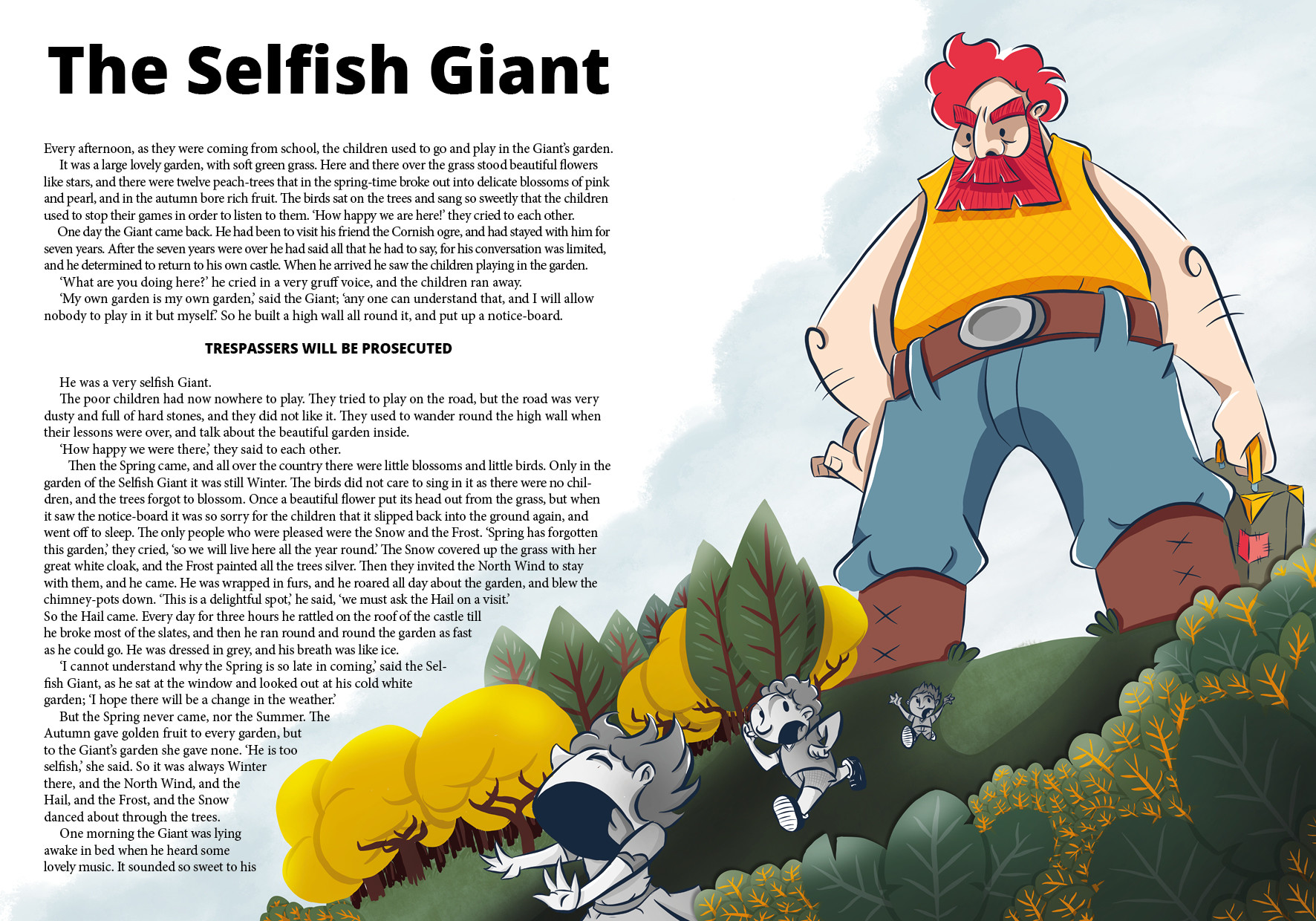

Source: https://florestadelavolpe.artstation.com/projects/Vx6gP?album_id=746652


Comments

Post a Comment

Popular posts from this blog

CONTENTS OF THE DEAD MAN’S POCKET

Contents of the Dead Man’s Pocket is a short story by  Jack Finney , originally published by both   Good Housekeeping   and   Collier’s   in 1956 . The story is a suspenseful tale of a man who travels onto a hazardous window ledge (ridge) to retrieve the papers he believes will make his career. Finney was a prolific (creative) writer, recognized for his science fiction novels   The Body Snatchers   and   Time and Again , as well as thrillers, such as   5 Against the House . The story begins with protagonist  Tom Benecke at a desk in the living room of his eleventh-floor apartment in New York City. He is preparing to type up a handwritten memo to be distributed to his office. He finds small ways to distract himself from starting. First, he tries to open a window, but it isn’t easily opened. He has to use quite a bit of force on the frame. Once the window is open, he continues to ignore the typewriter, crossing the room to talk t...

BBS First Year English Question Paper with Possible Answers (TU 2021)

FORMULAS OF ALL THE 12 TENSES

S + V + O || Subject + Verb + Object Simple Past Tense S + Past Form of the Verb + O  E.g. He wrote a letter. Past Continuous Tense S + was/were + V + ING + O  E.g. I was writing a letter.   Past Perfect Tense S + had + Past Participle (PP.) of the Verb + O  E.g. She had written a letter.   Past Perfect Continuous Tense S + had been + V + ING + O + since/for  E.g. We had been writing a letter since morning. Simple Present Tense S + V + O  E.g. You write a letter. Present Continuous Tense S + is/am/are + V + ING + O  E.g. She is writing a letter. Present Perfect Tense S + has/have + Past Participle (PP.) of the Verb + O  E.g. They have written a letter. Present Perfect Continuous Tense S + has been/have been + V + ING + O + since/for  E.g. You have been writing a letter for three hours. Simple Future Tense S + will/shall + V + O  E.g. We shall write a letter. Future Continuous Tense S +...

Summary and Analysis of Only Daughter by Sandra Cisneros

ONLY DAUGHTER -Sandra Cisneros Born into a working-class family in 1954, Sandra Cisneros was the daughter of a Mexican-American mother and a Mexican father.  Only Daughter originally appeared in Glamour magazine in 1990. Cisneros through this essay describes the difficulties of growing up as the only daughter in a Mexican-American family of six sons.   Historically, sons have been valued over daughters in most cultures, as reflected in the following proverbs: “A house full of daughters is like a cellar full of sour beer” (Dutch); “Daughters pay nae [no] debts” (Scottish); “A stupid son is better than a crafty daughter” (Chinese); and “A virtuous son is the sun of his family” (Sanskrit).  Contemporary research suggests that while the preference for male children has diminished considerably in industrialised nations, a distinct preference for sons continues among many cultures in Asia and the Middle East, raising concerns among medical ethicists worldwide. And, even within ...

Summary and Analysis of My Mother Never Worked

MY MOTHER NEVER WORKED Bonnie Smith - Yackel SYNOPSIS   In the essay “ My Mother Never Worked ,” Bonnie Smith-Yackel recollects the time when she called Social Security to claim her mother’s death benefits. Social Security places Smith-Yackel on hold so they can check their records on her mother, Martha Jerabek Smith . While waiting, she remembers the many things her mother did, and the compassion her mother felt towards her husband and children. When Social Security returns to the phone, they tell Smith-Yackel that she could not receive her mother’s death benefits because her mother never had a wage-earning job. A tremendous amount of irony is used in this essay. The title, in itself, is full of irony; it makes readers curious about the essay’s point and how the author feels about the situation. Smith-Yackel uses the essay to convey her opinion of work. Her thesis is not directly stated; however, she uses detail upon detail to prove her mother did work, just not in the eyes of ...

PROFESSIONS FOR WOMEN - Virginia Woolf (1882-1941)

Summary : Virginia Adeline Woolf (1882-1941) was an English novelist and essayist, regarded as one of the foremost modernist literary figures of the twentieth century. She was one of the leaders in the literary movement of modernism.  The speech of  Professions for Women  was given in 1931 to the Women’s Service League by Virginia Woolf. It was also included in  Death of a Moth  and  Other Essays  in 1942. Throughout the speech, Virginia Woolf brings forward a problem that is still relevant today:  gender inequality .   Woolf’s main point in this essay was to bring awareness to the phantoms (illusions) and obstacles women face in their jobs. Woolf argues that women must overcome special obstacles to become successful in their careers. She describes two hazards she thinks all women who aspire to professional life must overcome: their tendency to sacrifice their own interests to those of others and their reluctance (hesitancy) to challenge c...

Summary and Analysis of THE HIDDEN LIFE OF GARBAGE by Heather Rogers

  THE HIDDEN LIFE OF GARBAGE Heather Rogers Journalist Heather Rogers has written articles on the environmental effects of mass production and consumption for the  New York Times Magazine,  the  Utne Reader, Architecture,  and a variety of other publications.    Her 2002 documentary film  Gone Tomorrow: The Hidden Life of Garbage  has been screened at festivals around the world and served as the basis for a book of the same title. Named an Editor’s Choice by the  New York Times  and the  Guardian,  the book, published in 2005, traces the history and politics of household garbage in the United States, drawing connections between modern industrial production, consumer culture, and our contemporary throwaway lifestyle. Americans produce the most waste of any people on Earth, says Rogers, but few of us ever think about where all that trash goes. Rogers endeavours to show the inner workings of the waste stream, from the garbage...

THIRD THOUGHTS - E.V. Lucas, England (1868-1938)

E.V. Lucas, England (1868-1938) The story ‘ Third Thoughts ’ by E.V. Lucas (1868-1938) is a great satire of the common human mentality. This story was told to Lucas by his friend who had a business especially buying at dearer (higher) prices and selling at cheap. However, he always used to bear the loss. He used to think that one day luck would favour him. As he thought, once he earned abnormal profit by selling Turner’s panting at 50 pounds which he had bought at only 10 shillings from a curio (Something unusual -- perhaps worthy of collecting) shop at Cathedral city . He was really happy and excited for the first time in his business so he wanted to share half of his profit with the dealer. But since he had no stamps to send the parcel, he went to the bed.   When he woke up at 3.30 am, again he began to think that sharing half of the profit is not a good idea because no one had done this to him yet. Then he thought of giving ten pounds. Due to unexpectedly earning an abnormal ...

THE LADY WITH THE DOG (1899)

Anton Chekhov (1860-1904) Ø Tells the story of an affair o    Wealthy Banker ( Dmitry Gurov ) o    Young Wife ( Anna ) Ø Builds off of what is expected o    Affair was thought to be a quick experience o    These characters were surprised to find that not the case o    Specially the Banker  Ø After short affair they meet again o    Rekindle their relationship o    Develop a new chapter in their lives o    Discover themselves Ø The writer presents the Theme and Ideas o    Progression of Character: §    Moving from stereotype to developed §    Dmitri: Rich playboy with no depth becomes entwined with Anna. §    Anna: Moves from  The Lady with the Dog to someone with a name. ·        Relates to getting to know people as well as individual development. o    Open Ending and the Ability t...

A PAINFUL CASE

James Joyce Dubliners  is a collection of fifteen short stories by James Joyce, first published in 1914. The stories depict a naturalistic Irish middle class life in and around Dublin in the early years of the 20 th  century.   CHARACTERS: James Duffy Mrs Emily Sinico Captain Sinico (Ship Captain) Mary In  A Painful Case  by  James Joyce we have the theme of loneliness, isolation, guilt, order and paralysis. Taken from his Dubliners collection the story is narrated in the third person by an unnamed narrator and very early on in the story the reader realises that Joyce, through the use of colour, is highlighting to the reader how lonely the main character,  James Duffy ’s life is a middle-aged bachelor without family or friends, is a cashier in a private bank and lives a Spartan (simple) existence in a Dublin suburb. He dislikes physical and mental disorder, ignores beggars’ pleas for alms (charities), and does not attend church. Hi...